
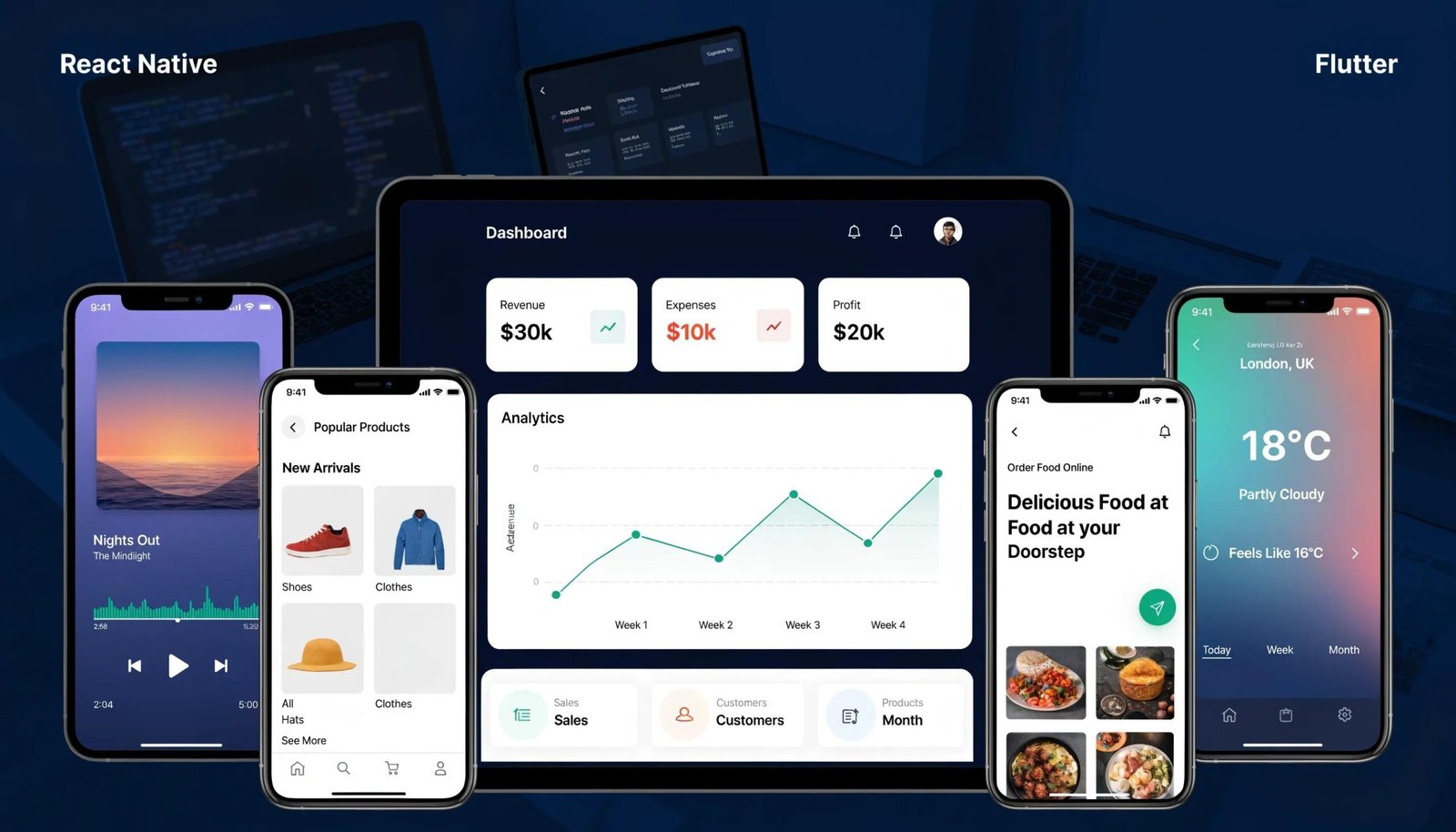

Reach More Users with Cross-Platform App Development: Expert Solutions Using React Native and Flutter
By Mustafa Sharif, Marketania
Mobile application strategies must prioritize multi-platform reach. This article compares React Native and Flutter and explains how a data-driven cross-platform approach can speed deployment, cut costs, and expand SME market reach, plus Marketania’s consultation support.
Key Takeaways
- Reach iOS and Android from one codebase.
- React Native: hot reload and broad community.
- Flutter: native compilation and rich UI widgets.
- Lower costs and faster deployments vs native.
- Consistent UX and simpler maintenance for SMEs.
- Choose based on UI needs, performance, and stack.
- Marketania offers free consultations to guide choice.
- Cross-platform supports broader reach and adaptability.
React Native

React Native uses a single JavaScript codebase to deliver iOS and Android apps. Hot reload speeds iteration, lowering development time and maintenance costs while supporting responsive UX.
Flutter
Flutter compiles natively and provides custom UI widgets, improving startup and animation performance. Its design tooling supports branded interfaces and rapid iteration for SMEs.
Compare compatibility, UI needs, performance goals, and maintenance when choosing a framework. Marketania can advise on trade-offs and roadmap alignment.
What Are the Key Benefits of Cross-Platform App Development for Small and Medium Businesses?
Cross-platform development lowers overhead, shortens releases, and delivers consistent experiences—boosting reach, efficiency, and ROI for SMEs.
- Cost-Effectiveness: Single codebase saves time and resources.
- Faster Deployment: Quicker release cycles accelerate market entry.
- Broader Market Reach: One build reaches more users across platforms.
Marketania offers free consultations to align strategy with growth targets.
Why SMEs Choose Cross-Platform Solutions for Cost-Effective Digital Expansion
SMEs select cross-platform frameworks for consistent UX, lower maintenance, and access to more developers, enabling faster feature delivery.
- Consistency in User Experience: Unified UI ensures brand consistency across devices.
- Easier Maintenance: Single codebase reduces update effort.
- Access to a Larger Talent Pool: Wider pool of developers simplifies hiring.
Marketania helps identify strategies to maximise these benefits.
How Do React Native and Flutter Compare as Leading Cross-Platform Frameworks?
Compare performance, productivity, UI flexibility, and ecosystem support. Choose based on roadmap and benchmarks.
| Framework | Feature | Benefit |
|---|---|---|
| React Native | Hot Reloading | Live updates without losing state |
| Flutter | Native Compilation | High performance and fast load times |
| React Native | Large Community Support | Extensive resources and plugins available |
| Flutter | Custom UI Widgets | Flexibility in designing a unique application look |
Both frameworks suit different needs; align choice with product goals and performance criteria.
What Are the Differences Between Cross-Platform and Native App Development?
Native apps often offer higher performance and platform features; cross-platform reduces duplication and cost via one codebase.
- Performance Benefits of Native Apps: Native is best for performance-intensive features.
- Development Costs Comparison: Cross-platform is generally less expensive due to reuse.
- Ideal Use Scenarios for Each Type: Cross-platform suits general apps; native for heavy graphics/animations.
Match model to product needs to decide.
How to Decide the Best Cross-Platform Tools for Your Business Needs
Consider compatibility with your stack, measured performance, and required UI customisation; prioritise criteria that match your roadmap.
- Compatibility Factors: Assess integration with current systems.
- Performance Benchmarks: Run benchmarks for speed and responsiveness.
- User Interface Customization: Check design flexibility and theming support.
Use evaluation matrices and data to choose tools.
How Can Marketania’s Free Consultation Support Your Cross-Platform App Strategy?
Marketania offers feasibility assessment, technical guidance, and feature planning informed by market analysis and user insights.
- Idea Review for Feasibility: Assess concept viability against market trends.
- Technical Guidance for Platform Selection: Recommend frameworks and integration approaches.
- Feature Planning for User Experience: Define features that drive engagement and retention.
Consultations align roadmaps with measurable objectives.
Client Success Stories Demonstrating Sustained Growth Through Tailored App Solutions
Clients saw growth after tailored cross-platform solutions, with faster iteration and improved UX driving monetisation and responsiveness.
- Increased Engagement: Better UX and features increased user engagement.
- Revenue Growth: Faster releases and lower costs improved profitability.
- Market Adaptability: Cross-platform flexibility aided quick market pivots.
These cases show strategic choices and data-driven iteration support growth.
Frequently Asked Questions
1. What challenges do businesses face when transitioning to cross-platform app development?
Transitioning requires workflow changes and training. Plan for cross-platform testing and a phased roadmap to manage device-specific integrations and performance trade-offs.
2. Are there specific industries that benefit most from cross-platform app development?
Retail, e-commerce, startups, healthcare, education, and entertainment often benefit from cross-platform reach and faster iteration cycles.
3. How does user feedback influence the development of cross-platform apps?
User feedback and analytics guide priorities. Iterative updates based on real usage improve retention and engagement.
4. Can you integrate native features into cross-platform applications?
Yes. Both frameworks support native modules to access camera, GPS, push notifications, and other device APIs; complexity varies by feature.
5. What are the long-term maintenance implications of using cross-platform app development?
A single codebase simplifies updates and reduces costs, but teams must manage SDK changes and framework updates; good documentation and skilled staff are essential.
6. What resources are available for businesses starting with cross-platform development?
Use official docs, online courses, and communities to onboard. Strategic consultations like Marketania’s speed feasibility analysis and planning.
7. How do I measure the success of a cross-platform app?
Track KPIs such as downloads, retention, engagement, conversions, reviews, revenue, and acquisition cost; review regularly to inform product and marketing.
Conclusion
Choosing React Native or Flutter can improve efficiency, lower costs, and expand reach. A data-driven selection aligned to UX and performance goals yields competitive advantage. Contact Marketania for tailored strategy and measurable outcomes.